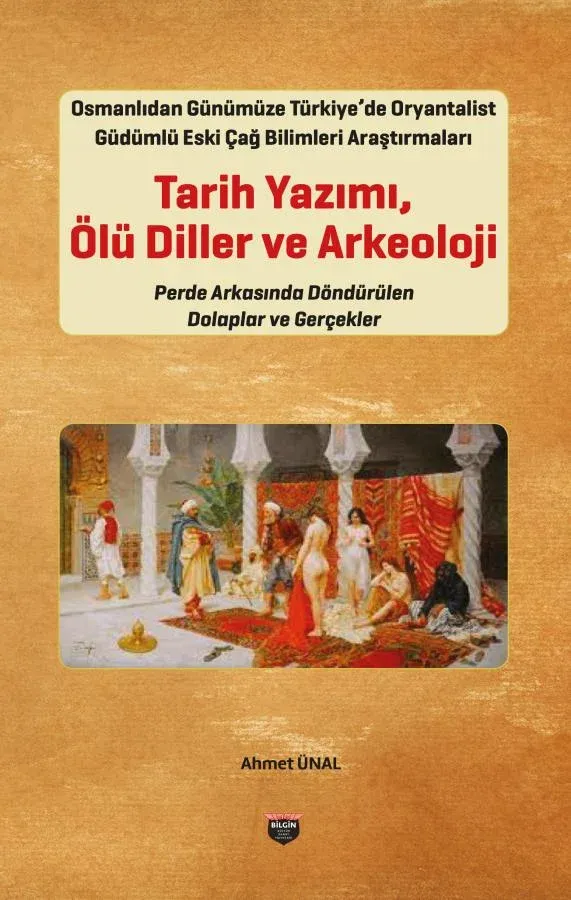

Orientalist-Oriented Ancient Sciences Research in Turkey from the Ottoman Empire to the Present: Historiography, Dead Languages, and Archaeology: Behind-the-scenes Machinations and Realities Osmanlıdan Günümüze Türkiye’de Oryantalist Güdümlü Eski Çağ Bilimleri Araştırmaları Tarih Yazımı, Ölü Diller ve Arkeoloji Perde Arkasında Döndürülen Dolaplar ve Gerçekler
There are invisible forces and unwritten laws that meticulously, secretly monitor, control, and direct the course and development of underdeveloped societies. They begin by researching the pasts of the societies concerned. Based on this, they direct their current situation and future, shaping economics, religion, culture, and politics as they please with historical and archaeological data. Although they become the subject of inappropriate research and fiction due to excessive curiosity, they never reveal their identity and mysteries. Orientalists are among the most important of these driving instruments and dynamics, and they keep the lands of Anatolia, where we live, under close scrutiny. Most people are unaware of what is happening. Indeed, almost everyone assumes that the Near East's greatest asset is oil. However, as the cradle of civilization, its archaeology is closely tied to it in the cultural arena as a complementary element. Turkey, deprived of oil, has its sole commodity, along with minerals, archaeology, which it does not consider a national asset, but rather utilizes primarily for tourism. Until both these blessings came to the attention of Western researchers and imperialists, almost the entire region was under Turkish/Ottoman control, but they didn't care. Much has been written about the political, literary, military, and economic aspects of Orientalism, but there is no solid research focused on archaeology and ancient studies, particularly Anatolia. As long as societies fail to utilize historical and archaeological assets for their own benefit and leave them to be exploited and plundered by others, they have no authority beyond possessing them and acting as guardians of museums and archaeological sites! The issue can be summarized as how Western scholars discovered, compiled, deciphered, systematically evaluated, and most importantly, subjected to self-serving and biased interpretations in many respects, shaped them as they pleased, and ruthlessly exploited them in violation of scientific and ethical principles. This research will explain what this ambiguous concept is and how it influenced and shaped ancient sciences, including archaeology, and historiography. The Turks, who lived and ruled in these lands, the main target of Orientalists, have failed to develop a science and methodology that independently interprets, explains, and assimilates historical sources and archaeological artifacts in accordance with their own cultural needs, structures, and interests. They have been unable to read, let alone decipher, texts from over half a dozen dead languages, including their own national language, Gokturk, in a way they understand and in line with their own interests and perspectives. They have ignored other material and spiritual values that Westerners have appropriated and used as unique sources through the Torah, the Bible, and Hellenism. In Turkey, archaeology is perceived as the driving force of all ancient sciences, and as practiced, it is not a science but a visual art form. It is solely the science of excavation and does not concern itself with the interpretation of finds. It is quite easy to conduct and, moreover, prestigious. Its unique structure and the influence of Egyptian and Inca archaeology make it seem like it's full of secrets, positioning archaeologists as mystery hunters, thus possessing occult connections, being socialites, and being viewed as an intellectual pursuit. When archaeology is so simplified, transformed from the "science of the ancients" into the "science of excavation," then, with some exceptions, those conducting excavations in Turkey should not be called "archaeologists." Just as we wouldn't call a "quarry baron" who lacks the skills to use the stones he quarries in his architecture and sculpture, who markets them to China and fattens his pockets, a "stonemason," so too should we not call those who fail to independently publish, interpret, and evaluate the artifacts they excavate and find, who constantly work under the guidance and support of Orientalists in every way possible. All of these and other closely related topics are discussed in the book with clear and unsparing language.
Product weight: 0.692 grams
There are invisible forces and unwritten laws that meticulously, secretly monitor, control, and direct the course and development of underdeveloped societies. They begin by researching the pasts of the societies concerned. Based on this, they direct their current situation and future, shaping economics, religion, culture, and politics as they please with historical and archaeological data. Although they become the subject of inappropriate research and fiction due to excessive curiosity, they never reveal their identity and mysteries. Orientalists are among the most important of these driving instruments and dynamics, and they keep the lands of Anatolia, where we live, under close scrutiny. Most people are unaware of what is happening. Indeed, almost everyone assumes that the Near East's greatest asset is oil. However, as the cradle of civilization, its archaeology is closely tied to it in the cultural arena as a complementary element. Turkey, deprived of oil, has its sole commodity, along with minerals, archaeology, which it does not consider a national asset, but rather utilizes primarily for tourism. Until both these blessings came to the attention of Western researchers and imperialists, almost the entire region was under Turkish/Ottoman control, but they didn't care. Much has been written about the political, literary, military, and economic aspects of Orientalism, but there is no solid research focused on archaeology and ancient studies, particularly Anatolia. As long as societies fail to utilize historical and archaeological assets for their own benefit and leave them to be exploited and plundered by others, they have no authority beyond possessing them and acting as guardians of museums and archaeological sites! The issue can be summarized as how Western scholars discovered, compiled, deciphered, systematically evaluated, and most importantly, subjected to self-serving and biased interpretations in many respects, shaped them as they pleased, and ruthlessly exploited them in violation of scientific and ethical principles. This research will explain what this ambiguous concept is and how it influenced and shaped ancient sciences, including archaeology, and historiography. The Turks, who lived and ruled in these lands, the main target of Orientalists, have failed to develop a science and methodology that independently interprets, explains, and assimilates historical sources and archaeological artifacts in accordance with their own cultural needs, structures, and interests. They have been unable to read, let alone decipher, texts from over half a dozen dead languages, including their own national language, Gokturk, in a way they understand and in line with their own interests and perspectives. They have ignored other material and spiritual values that Westerners have appropriated and used as unique sources through the Torah, the Bible, and Hellenism. In Turkey, archaeology is perceived as the driving force of all ancient sciences, and as practiced, it is not a science but a visual art form. It is solely the science of excavation and does not concern itself with the interpretation of finds. It is quite easy to conduct and, moreover, prestigious. Its unique structure and the influence of Egyptian and Inca archaeology make it seem like it's full of secrets, positioning archaeologists as mystery hunters, thus possessing occult connections, being socialites, and being viewed as an intellectual pursuit. When archaeology is so simplified, transformed from the "science of the ancients" into the "science of excavation," then, with some exceptions, those conducting excavations in Turkey should not be called "archaeologists." Just as we wouldn't call a "quarry baron" who lacks the skills to use the stones he quarries in his architecture and sculpture, who markets them to China and fattens his pockets, a "stonemason," so too should we not call those who fail to independently publish, interpret, and evaluate the artifacts they excavate and find, who constantly work under the guidance and support of Orientalists in every way possible. All of these and other closely related topics are discussed in the book with clear and unsparing language.
Product weight: 0.692 grams