
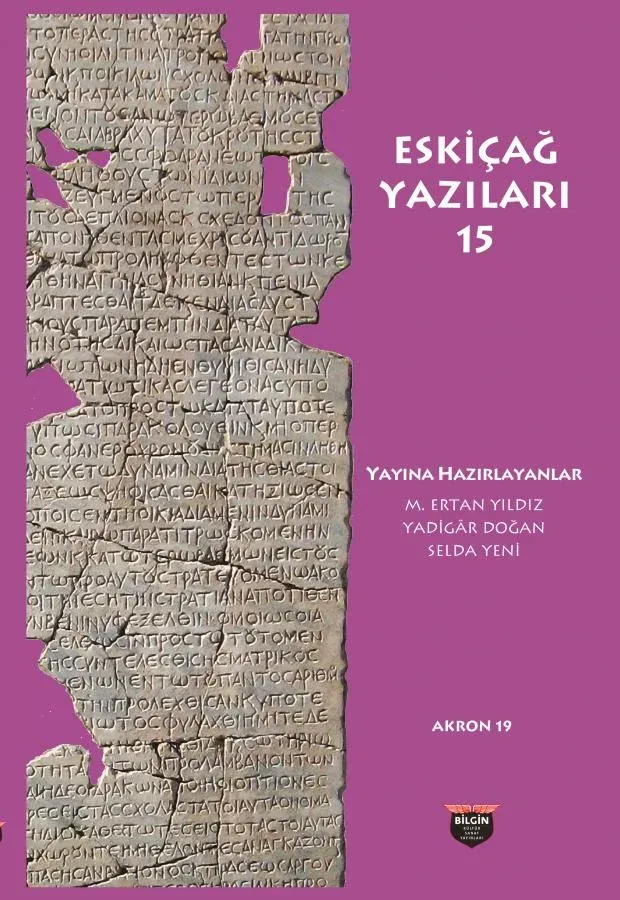

"Ancient Writings 15" consists of articles that bring together various topics that open doors to the ancient period. Ancient Writings is published to share our scholars' thoughts on the subject with the public in an easily understandable style, thereby building a bridge between the ancient period and the present day.
The first article in the book is titled "A Study of the Kragos Surroundings in Lycia: Sidyma and Kalabatia," written by Fatih Onur. The article discusses the road route depicted in line 11 of the B side of the Patara Road Monument, also known as the Stadiasmus Patarensis. In his work, the author highlights both the incompleteness associated with completion and the fact that the distance given for the missing target does not match the distance shown on the monument. The article is of great importance for offering new propositions regarding the historical geography of Lycia.
In the second article of the book, Zeynep Sencan Altınoluk introduces to the scholarly world a coin minted in the name of Roman Emperor Marcus Aurelius by the city of Amastris (Amasra) in the Paphlagonia Region, titled "A New Homeric Type on Amastris Coins: Homer, Ilias, and Odyssey." This article, which includes the first documented reverse depiction and detailed evaluations, makes a significant contribution to the iconography of Homer, Ilias, and Odyssey.
The third article of the book, written by Elif Akgün Kaya, is titled "Women Philosophers in Ancient Greek Philosophy: The Philosophical Schools They Followed and Their Social Positions." This article lists the female philosophers identified through information obtained from ancient writers, and provides information on their schools of affiliation, their educational and professional fields, and their positions in the public sphere.
In the fourth article, "An Athenian in Miletupolis. The Classical Tombstone of Hypermenes as a Key Document for the Relationship between Miletupolis and Athens," N. Eda Akyürek Şahin introduces a funerary stele from the Bursa Museum. This funerary stele, discovered in Miletupolis, is of great significance both for its depiction of a "man and dog" and for its record of an Athenian who lived in the city.
The fifth article in the book is titled "Gold Lamellae from the Necropolis of Iuliopolis." Author Melih Arslan introduces two gold amulets (amulets) and four inscribed gold lamellae plaques discovered in the Necropolis of Iuliopolis.
The sixth article in the book, which outlines the biography of Flavius Belisarius, a prominent commander of Late Antiquity, was written by Emine Bilgiç Kavak and is titled "Shadowed Splendor: A Portrait of Roman Commander Belisarius." The author examines Belisarius's military career in detail from its early stages.
The seventh article in the book is titled "The Cult of Saturnus in Ancient Roman Religion," by Etem Dönmez. This article examines the etymology of the word Saturnus, the emergence of the Saturnus Cult, and its historical development, by evaluating ancient sources and modern literature together.
The eighth article in the book, "Templon Arrangement in Byzantine Church Architecture," written by Ceren Demirton, examines templon arrangements chronologically using ancient sources and excavation findings. This study contributes to the study of Byzantine church architecture.
Ecem Akkaya's study, "A Feminist Perspective in Archaeological Knowledge Production: Feminist Archaeology," examines the impact of feminist theory, which is increasingly prevalent within the social sciences, on the field of archaeology and constitutes the ninth chapter in the book. After listing studies in these fields chronologically, the author discusses their position and importance within Turkish archaeology.
The tenth chapter in the book, "Disabled People in Antiquity," is written by Ahmet Mörel. The article primarily addresses the terms used to define "disability" in antiquity. This chapter is important because it provides a general assessment of the subject of "disability," a topic not widely available in Turkish literature related to the ancient period.
The eleventh chapter in the book, "Societies/Collegia in the Greco-Roman World: A General Assessment," is written by Gülden Peker. Drawing on ancient sources and epigraphic data, the author provides a detailed examination of the institutions we call "associations" in modern terminology during the ancient period.
The twelfth article in the book is titled "Epigrams from Anatolia," and the seventh in an ongoing series, "Epigrams from Oinoanda." This article, presented by Büşra Karabulut, introduces eight epigrams from Oinoanda.
İÇİNDEKİLER
Editörlerden
M. Ertan YILDIZ – Yadigâr DOĞAN – Selda YENİ
VII
Lykia’da Kragos Çevresinde Bir İnceleme:
Sidyma ve Kalabatia
Fatih ONUR
1
Amastris Sikkelerinde Yeni Bir Homeros Tipi:
Homeros, Ilias, Odysseia
Zeynep Sencan ALTINOLUK
77
Eskiçağ Yunan Felsefesinde Kadın Filozoflar:
Takip Ettikleri Felsefe Okulları ve Sosyal Konumları
Elif AKGÜN KAYA
115
Miletupolis Kenti’nde Bir Atinalı.
Miletupolis ve Atina Arasındaki İlişkiye Yeni Bir Belge Olarak
Hypermenes’in Klasik Dönem’e Ait Mezar Taşı
N. Eda AKYÜREK ŞAHİN
161
Iuliopolis Nekropolü’nden Altın Lamellalar
Melih ARSLAN
209
Gölgelenen İhtişam:
Romalı Komutan Belisarius’un Portresi
Emine BİLGİÇ KAVAK
243
VI
Antik Roma Dini’nde Saturnus Kültü
Etem DÖNMEZ
261
Bizans Dönemi Kilise Mimarisinde Templon Düzenlemesi
Ceren DEMİRTON
287
Arkeolojik Bilgi Üretiminde Feminist Perspektif:
Feminist Arkeoloji
Ecem AKKAYA
313
Antik Dönem’de Engelliler
Ahmet MÖREL
325
Yunan-Roma Dünyasında Dernekler/Collegia:
Genel Bir Değerlendirme
Gülden PEKER
337
Anadolu’dan Epigramlar 7: Oinoanda Epigramları
Büşra KARABULUT
373
Platon’un Bilgi Felsefesi
Elif AKGÜN KAYA
407
Ürünün ağırlığı: 0,840 gram
"Ancient Writings 15" consists of articles that bring together various topics that open doors to the ancient period. Ancient Writings is published to share our scholars' thoughts on the subject with the public in an easily understandable style, thereby building a bridge between the ancient period and the present day.
The first article in the book is titled "A Study of the Kragos Surroundings in Lycia: Sidyma and Kalabatia," written by Fatih Onur. The article discusses the road route depicted in line 11 of the B side of the Patara Road Monument, also known as the Stadiasmus Patarensis. In his work, the author highlights both the incompleteness associated with completion and the fact that the distance given for the missing target does not match the distance shown on the monument. The article is of great importance for offering new propositions regarding the historical geography of Lycia.
In the second article of the book, Zeynep Sencan Altınoluk introduces to the scholarly world a coin minted in the name of Roman Emperor Marcus Aurelius by the city of Amastris (Amasra) in the Paphlagonia Region, titled "A New Homeric Type on Amastris Coins: Homer, Ilias, and Odyssey." This article, which includes the first documented reverse depiction and detailed evaluations, makes a significant contribution to the iconography of Homer, Ilias, and Odyssey.
The third article of the book, written by Elif Akgün Kaya, is titled "Women Philosophers in Ancient Greek Philosophy: The Philosophical Schools They Followed and Their Social Positions." This article lists the female philosophers identified through information obtained from ancient writers, and provides information on their schools of affiliation, their educational and professional fields, and their positions in the public sphere.
In the fourth article, "An Athenian in Miletupolis. The Classical Tombstone of Hypermenes as a Key Document for the Relationship between Miletupolis and Athens," N. Eda Akyürek Şahin introduces a funerary stele from the Bursa Museum. This funerary stele, discovered in Miletupolis, is of great significance both for its depiction of a "man and dog" and for its record of an Athenian who lived in the city.
The fifth article in the book is titled "Gold Lamellae from the Necropolis of Iuliopolis." Author Melih Arslan introduces two gold amulets (amulets) and four inscribed gold lamellae plaques discovered in the Necropolis of Iuliopolis.
The sixth article in the book, which outlines the biography of Flavius Belisarius, a prominent commander of Late Antiquity, was written by Emine Bilgiç Kavak and is titled "Shadowed Splendor: A Portrait of Roman Commander Belisarius." The author examines Belisarius's military career in detail from its early stages.
The seventh article in the book is titled "The Cult of Saturnus in Ancient Roman Religion," by Etem Dönmez. This article examines the etymology of the word Saturnus, the emergence of the Saturnus Cult, and its historical development, by evaluating ancient sources and modern literature together.
The eighth article in the book, "Templon Arrangement in Byzantine Church Architecture," written by Ceren Demirton, examines templon arrangements chronologically using ancient sources and excavation findings. This study contributes to the study of Byzantine church architecture.
Ecem Akkaya's study, "A Feminist Perspective in Archaeological Knowledge Production: Feminist Archaeology," examines the impact of feminist theory, which is increasingly prevalent within the social sciences, on the field of archaeology and constitutes the ninth chapter in the book. After listing studies in these fields chronologically, the author discusses their position and importance within Turkish archaeology.
The tenth chapter in the book, "Disabled People in Antiquity," is written by Ahmet Mörel. The article primarily addresses the terms used to define "disability" in antiquity. This chapter is important because it provides a general assessment of the subject of "disability," a topic not widely available in Turkish literature related to the ancient period.
The eleventh chapter in the book, "Societies/Collegia in the Greco-Roman World: A General Assessment," is written by Gülden Peker. Drawing on ancient sources and epigraphic data, the author provides a detailed examination of the institutions we call "associations" in modern terminology during the ancient period.
The twelfth article in the book is titled "Epigrams from Anatolia," and the seventh in an ongoing series, "Epigrams from Oinoanda." This article, presented by Büşra Karabulut, introduces eight epigrams from Oinoanda.
İÇİNDEKİLER
Editörlerden
M. Ertan YILDIZ – Yadigâr DOĞAN – Selda YENİ
VII
Lykia’da Kragos Çevresinde Bir İnceleme:
Sidyma ve Kalabatia
Fatih ONUR
1
Amastris Sikkelerinde Yeni Bir Homeros Tipi:
Homeros, Ilias, Odysseia
Zeynep Sencan ALTINOLUK
77
Eskiçağ Yunan Felsefesinde Kadın Filozoflar:
Takip Ettikleri Felsefe Okulları ve Sosyal Konumları
Elif AKGÜN KAYA
115
Miletupolis Kenti’nde Bir Atinalı.
Miletupolis ve Atina Arasındaki İlişkiye Yeni Bir Belge Olarak
Hypermenes’in Klasik Dönem’e Ait Mezar Taşı
N. Eda AKYÜREK ŞAHİN
161
Iuliopolis Nekropolü’nden Altın Lamellalar
Melih ARSLAN
209
Gölgelenen İhtişam:
Romalı Komutan Belisarius’un Portresi
Emine BİLGİÇ KAVAK
243
VI
Antik Roma Dini’nde Saturnus Kültü
Etem DÖNMEZ
261
Bizans Dönemi Kilise Mimarisinde Templon Düzenlemesi
Ceren DEMİRTON
287
Arkeolojik Bilgi Üretiminde Feminist Perspektif:
Feminist Arkeoloji
Ecem AKKAYA
313
Antik Dönem’de Engelliler
Ahmet MÖREL
325
Yunan-Roma Dünyasında Dernekler/Collegia:
Genel Bir Değerlendirme
Gülden PEKER
337
Anadolu’dan Epigramlar 7: Oinoanda Epigramları
Büşra KARABULUT
373
Platon’un Bilgi Felsefesi
Elif AKGÜN KAYA
407
Ürünün ağırlığı: 0,840 gram